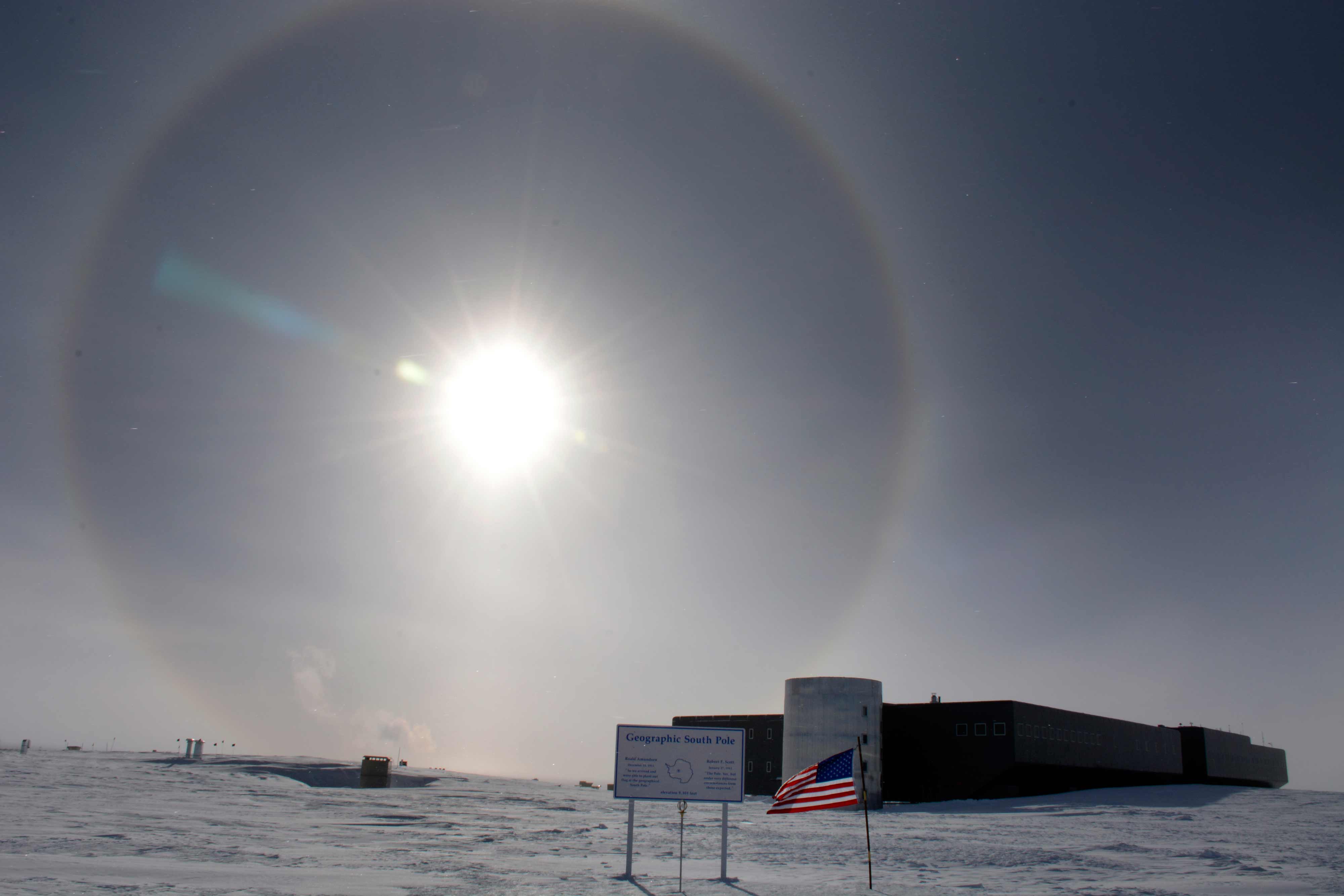
Imagine standing at a spot where every single direction you look is North. It’s disorienting. You’re at 9,301 feet above sea level, but because the air is so thin and the centrifugal force of the Earth's rotation thins the atmosphere at the poles, your body feels like it's at 11,000 feet. You’re breathing hard just standing still. This is the Amundsen-Scott South Pole Station, a place that shouldn't really exist, yet it’s been continuously occupied since 1956. Most people think of it as a lonely little shack in the snow. Honestly? It’s more like a high-tech space station bolted onto a desert of ice.
It’s bone-dry. Technically, the South Pole is a desert. You'd think with all that ice—nearly two miles of it beneath your boots—it would be wet, but the humidity is basically zero. This plays havoc with your skin and electronics. Static electricity becomes a genuine workplace hazard. If you touch a door handle without grounding yourself, you might actually fry a circuit board or give yourself a jolt that feels like a physical punch.
The Brutal Reality of Living at 90 Degrees South
Living at the Amundsen-Scott South Pole Station isn't for everyone. In fact, for most of the year, it's not for anyone except a skeleton crew of about 40 people. During the "winter-over" period, which lasts from mid-February to late October, nobody goes in and nobody goes out. Once the last plane leaves, you are more isolated than the astronauts on the International Space Station. If your appendix bursts in June, you aren't going to a hospital. You’re being operated on by whatever doctor is on-site, perhaps with guidance over a satellite link.
The temperature? It’s absurd. We aren't talking "winter in Minnesota" cold. We're talking -100°F. At those temperatures, steel becomes brittle and can snap like glass. If you throw a cup of boiling water into the air, it hisses into a cloud of ice crystals before it even hits the ground. This is the world the "Winterovers" inhabit. They live in a massive, elevated structure designed to keep the station from being buried by drifting snow.
See, the previous stations—the 1956 "Old Pole" and the iconic 1970s geodesic dome—eventually got swallowed. The weight of the accumulating snow is immense. To solve this, the current station, completed around 2008, sits on hydraulic stilts. As the snow builds up, they can actually jack the entire building higher. It’s a multi-million dollar game of "the floor is lava," except the lava is ice and it never stops rising.
Why Science Loves This Frozen Hellscape
Why bother? It sounds miserable. It's expensive. It's dangerous. But the Amundsen-Scott South Pole Station is arguably the best place on Earth for specific types of science.
Take the South Pole Telescope (SPT). Because the air is so cold and dry, there’s almost no water vapor to interfere with submillimeter waves from space. This allows cosmologists to look at the Cosmic Microwave Background—the afterglow of the Big Bang—with incredible clarity. Then there’s IceCube. No, not the rapper. The IceCube Neutrino Observatory is a massive detector buried deep in the ice. It uses a cubic kilometer of Antarctic ice to catch "ghost particles" called neutrinos. These particles are so small they pass through almost everything, but every once in a while, one hits an atom in the ice and creates a flash of light.
- Scientists use hot-water drills to melt holes 1.5 miles deep.
- Strings of light sensors are lowered into these holes.
- The ice then freezes back around them, turning the entire glacier into a giant camera.
It’s brilliant. It’s also the kind of thing you can only do when you have a stable, two-mile-thick block of some of the purest ice on the planet.
The Social Quirkiness of "The Pole"
Socially, the station is a trip. You have PhD physicists rubbing elbows with heavy equipment mechanics and cooks. Everyone eats in the same galley. There’s a small gym, a music room, and a library. But the "Three Hundred Club" is probably the most famous (or infamous) tradition. When the temperature hits -100°F, some brave—or crazy—souls heat up a sauna to 200°F. They sit there until they're roasting, then run outside wearing nothing but boots and maybe a neck gaiter to circle the geographic South Pole marker. A 300-degree temperature swing. It’s a rite of passage that most doctors would probably advise against, yet it happens every year.
There’s a weird sense of humor that develops when you don’t see the sun for six months. You start to value the small things. Fresh vegetables, or "freshies," are treated like gold. When the first plane arrives in the spring after eight months of frozen and canned food, the sight of a real orange can bring grown adults to tears.
Logistics: The Impossible Task of Toilets and Trash
Everything at the Amundsen-Scott South Pole Station has to be flown in or dragged across the ice on the "McMurdo-South Pole Traverse." This is a 1,000-mile tractor trek from the coast. It’s not a road. It’s a flagged path over a moving ice sheet full of hidden crevasses.
Fuel is the lifeblood of the station. Without it, the generators stop, the heat dies, and everyone follows shortly after. They use AN-8, a special type of jet fuel that doesn't freeze at those temperatures. And what goes in must come out. You can't just dump trash or sewage in Antarctica; the Antarctic Treaty is very strict about that. Human waste is processed, and the solids are dried, crated, and eventually shipped off the continent. You are basically living in a closed-loop system where every scrap of plastic is accounted for.
Misconceptions About the "Actual" Pole
People think the station is right on top of the South Pole. Well, it is, but also it isn't. There are actually two poles. There’s the Geographic South Pole, which is the fixed point of the Earth's axis. Then there’s the station itself, which sits on an ice sheet that is moving. The ice at the South Pole is sliding toward the Weddell Sea at a rate of about 33 feet per year.
Every New Year’s Day, they have a little ceremony to move the Geographic South Pole marker. They calculate exactly where the axis is, and they stick a new, custom-designed brass marker in the snow. The old markers are left in the ice and slowly march away toward the coast, a line of breadcrumbs showing exactly how much the world is shifting beneath the researchers' feet.
The Future of Amundsen-Scott South Pole Station
The station is aging. Despite its futuristic look, the harsh environment is relentless. Maintenance is a 24/7 job. There are talks about what comes next, especially as the demand for "Big Science" grows. The need for more power, better internet (which is currently limited to a few hours a day when old satellites pass over), and more living space is constant.
However, funding is always a battle. The National Science Foundation (NSF) manages the United States Antarctic Program, and they have to balance the South Pole's needs against other stations like McMurdo or Palmer. But the South Pole is the crown jewel. It’s a symbol of international cooperation and human endurance.
If you’re thinking about going, you’d better be an elite scientist or a very skilled tradesperson. Or very, very rich—tourists do visit, landing on the blue-ice runway for a few hours, snapping a photo with the barber-pole-striped marker, and leaving before the cold really sinks into their bones. But to truly know the place, you have to stay. You have to experience the "Big Eye," the insomnia caused by 24-hour sunlight, or the soul-crushing silence of the Antarctic night.
Navigating the Reality of the South Pole
If you're genuinely interested in the operations or perhaps even working at the Amundsen-Scott South Pole Station, here is the realistic path forward.
First, understand the physical requirements. The NSF requires a rigorous "Physical Qualification" (PQ) process. This isn't just a standard checkup; it’s an intense screening of your heart, teeth, and mental health. They don't want someone needing a root canal or a cardiac specialist in the middle of a polar winter.
Second, look at the contractors. Most of the support roles—from cooks to carpenters—are handled by companies like Leidos or their subcontractors (PAE, GSC). They start hiring for the summer season months in advance.
Third, monitor the USAP (United States Antarctic Program) website for research grants if you’re in the academic world. The competition is fierce, and your science has to be "uniquely Antarctic"—meaning it can't be done anywhere else.
Finally, keep your expectations in check. It is not a vacation. It is a high-altitude, low-oxygen, hyper-isolated industrial site where the weather is trying to kill you. But for those who have seen the Aurora Australis dance over the station during the long night, there is nowhere else on Earth they’d rather be.
The station stands as a testament to the fact that we can live almost anywhere if we’re clever enough, and if we're willing to haul our own trash 1,000 miles back to the ocean.
To learn more about the current staffing and operational status of the station, check the official United States Antarctic Program portal. They provide live weather feeds and updates on the latest scientific breakthroughs from the ice. For those curious about the history, the Scott Polar Research Institute at the University of Cambridge holds the primary archives of the early expeditions that paved the way for this permanent presence at the end of the world.